
How AI-Powered Identity Verification Helps Prevent CNP Fraud
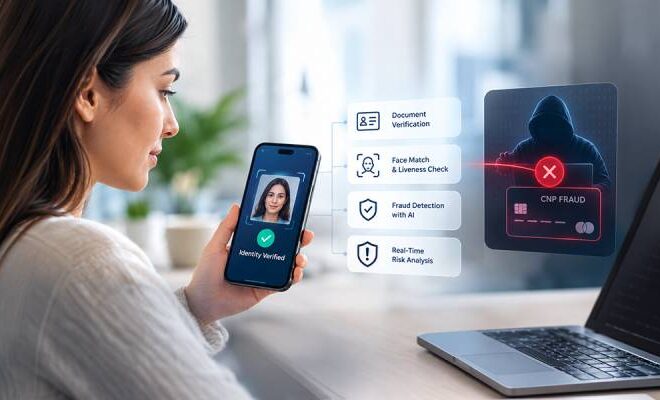
Online payments are convenient, but they also make card-not-present (CNP) fraud harder to detect because the person making the purchase never physically presents the card.
Traditional checks can catch some suspicious transactions, but they don’t always answer one key question: Is the person behind the transaction actually who they claim to be?
AI-powered identity verification adds another layer of protection by analyzing identity documents, biometrics, and risk signals to verify customers and flag suspicious activity.
Ahead in this blog post, we’ll discuss how AI-powered identity verification helps prevent CNP fraud, where traditional methods fall short, the AI technologies involved, and key implementation considerations.
What Is CNP Fraud?
Card-not-present (CNP) fraud occurs when someone uses stolen card information to make a purchase without physically presenting the card. This is common in ecommerce, where merchants typically can’t see the customer or verify that the person making the purchase is the actual cardholder.
Why Traditional Fraud Prevention Tactics Are Becoming Outdated
Traditional controls such as card verification value (CVV) checks, address verification, multifactor authentication, and transaction monitoring still have an important role in fraud prevention. The problem is relying on any one method to identify every fraudulent transaction.
Password-Based Authentication
A password confirms that someone knows a particular credential. However, it doesn’t prove that they are legitimate account owners. If a fraudster obtains a customer’s credentials, they may be able to access the account and use saved payment information without triggering a basic password check.
Manual Identity Checks
Manual verification can help with complex cases, but reviewing large numbers of customers manually isn’t practical for most ecommerce businesses. It can also introduce delays and inconsistencies that affect customer experience.
Rule-Based Fraud Detection
Rules work well to detect known risk scenarios, like very large transactions or repeated payment attempts. But if the fraudster changes tactics, then the fixed rule can have trouble coping. Machine learning can analyze many different signals and detect correlations that are not immediately apparent through a predefined rule.
Static Security Questions
Another form of authentication is security questions, which, however, can be compromised as well. When you use more robust authentication like biometrics, documents, and behavior data, it makes it tougher for the fraudster to use just the stolen personal information.
How AI Identity Verification Helps Prevent CNP Fraud
Identity verification using artificial intelligence is not a stand-alone solution to the problem of preventing CNP fraud; rather, it provides more protection at the identity layer.
Detects Suspicious User Behavior in Real-Time
Fraudulent activity often looks different from a customer’s normal behavior. Some examples include unusual login attempts from an unrecognized device, constant verification failures, and suspicious changes in accounts, among others. AI can help flag unusual behavior for further review before a transaction is completed.
Prevents Account Takeover Fraud
Account takeover can result in CNP fraud very quickly. A fraudster who managed to gain access to an authentic ecommerce account may already have access to the account’s saved payment methods, addresses, and other trusted details. Hence, such a transaction may be considered legitimate. In this case, AI identity verification may be used as an additional layer that is activated when suspicious activity occurs on the account.
Identifies Fake and Synthetic Identities
Identity thieves do not always require an entirely made-up identity. Synthetic identity theft is when some combination of real and fake information is used to develop an identity. AI-based verification can examine document images, identity details, and biometric signals for inconsistencies that may indicate a fraudulent or synthetic identity.
Improves Transaction Risk Assessment
Identity information becomes more useful when it is evaluated alongside other fraud signals. For example, a transaction from a known customer using a familiar device and consistent account information may present relatively low risk. A different transaction involving a new device, unusual behavior, a recently changed payment method, and an identity mismatch present a very different picture. AI can help bring these signals together, so businesses can make a more contextual risk assessment.
Reduces False Positives
Fraud prevention isn’t just about catching bad transactions. It’s also about avoiding unnecessary declines that frustrate legitimate customers. By considering multiple signals instead of relying on a single risk factor, AI can help businesses make more informed decisions about which transactions need additional verification.
Supports Continuous Identity Monitoring
Identity verification should not always be considered complete just because an account has been opened. The risk rating for an individual may vary in case he signs into an account using a new device, changes his password, changes his account details, introduces a new mode of payment, or displays unusual behavior.
AI Technologies Used in CNP Fraud Prevention
Several AI technologies can contribute to a stronger identity and fraud prevention strategy.
AI Document Verification
AI document verification examines identity documents for signs of tampering, inconsistencies, and other characteristics associated with fraudulent documents. It can also automatically extract information from documents, reducing manual data entry during verification.
Biometric Authentication
Biometric verification can compare a customer’s face with the photograph on their identity document. This adds another layer of confidence because the system isn’t relying only on information that could have been stolen or copied.
Liveness Detection
A facial match alone isn’t always sufficient. Fraudsters can attempt to use photographs, videos, screens, or manipulated media during verification. Liveness detection helps determine whether the biometric interaction is coming from a real person rather than a presentation attack.
Machine Learning Fraud Models
Machine learning models can analyze large volumes of transaction and behavioral data to identify patterns associated with fraud. Rather than relying entirely on predefined rules, these models can assess multiple signals to determine the risk associated with an activity.
Risk-Based Authentication (RBA)
Risk-based authentication allows businesses to adjust the level of verification based on perceived risk. A low-risk customer may complete a normal checkout, while suspicious activity can trigger an additional identity or authentication step. This helps businesses strengthen security without creating unnecessary friction for every customer.
Generative AI Fraud Detection
Generative AI has also made fraud more sophisticated. Fraudsters can use AI to create or manipulate documents, images, and other identity-related content. As a result, modern verification systems need to account for increasingly convincing synthetic media and identity attacks.
Challenges and Considerations When Implementing AI Identity Verification
AI identity verification can strengthen fraud prevention, but implementation needs to be handled carefully.
Data Privacy Concerns
Personal identification may contain sensitive information that includes personal identity data as well as biometrics. Companies should have appropriate safeguards in place to protect this information throughout the verification process.
Accuracy and Bias Management
However, AI-based verification is not without flaws. It is prone to errors such as poor image quality, unusual documents, and constraints on its models. Companies need to track the accuracy of the AI and establish a review process in case of ambiguity.
Integration Challenges
AI identity verification also needs to work with a business’s existing ecommerce, payment, customer account, and fraud prevention systems. Otherwise, poor compatibility could cause disjointed workflow procedures that would make the identity verification process difficult.
Customer Adoption
Security shouldn’t come at the expense of a frustrating checkout experience. The requirement of showing IDs and taking selfies from all customers could complicate things further. Risk-based verification is one such solution that makes use of risk to trigger certain steps.
Conclusion
CNP fraud continues to evolve as ecommerce and digital payments grow. Stolen credentials, account takeovers, synthetic identities, and increasingly convincing forms of digital manipulation make it harder to determine whether an online transaction is genuinely coming from the customer.
AI-powered identity verification helps address this problem by adding stronger identity signals to the fraud prevention process. Document verification, biometrics, liveness detection, behavioral analysis, and risk-based authentication can work together to identify suspicious activity while keeping legitimate customers moving.